Jean Marc Lange · 1945
Archive
Biography, detailed chronology, exhibitions, publications and archive photographs, from sources gathered by the family and from catalogues.
Biography
1945 — 1964
Early years
Jean Marc Lange was born on 17 November 1945 in Canteleu. He spent his early childhood in Grand-Quevilly, a town on the banks of the Seine near Rouen. Very early on he showed a keen interest in everything to do with art. First came music, which he discovered with his younger brother Christian at the municipal music school; Christian Lange went on to the conservatoires of Rouen and Paris, where he studied with Olivier Messiaen. Above all, though, it was by tirelessly copying the reproductions of paintings and sculptures in the family’s large Larousse encyclopedia that Jean Marc Lange glimpsed the world he felt truly drawn to.
A few years later he painted his first beaches at Saint-Aubin-sur-Mer, in Normandy. Walking along the cliffs of Varengeville, he came across Georges Braque, whom he greatly admired. He greeted him respectfully, barely hiding his emotion; the few words they exchanged encouraged him in his plan to paint. It was a year before Braque’s death.
Admitted at fifteen to the École régionale des Beaux-Arts in Rouen, then directed by the architect François Herr, he was taught by his first masters: Messrs Mouillé, d’Andeville, Toublanc, Lessage, Savary, Leleu and Ramondot. He completed three years of general art studies, excelling in every subject to the point that each of his teachers urged him to take up their own speciality. Yet, forgoing the two further years that would have completed the course, he chose to go to Paris and take on the École nationale supérieure des Beaux-Arts: on 17 November 1964 the painter Maurice Brianchon accepted him into his studio.
1965
Paris, the joy of painting
Now entirely devoted to his passion, Jean Marc Lange worked relentlessly and was selected for the preliminary rounds of the Prix de Rome. Ranked first of the fourteen candidates admitted to the “montée en loges”, he had three months to complete a painting on the theme of the Dream (Le Songe). On 6 July 1965 a unanimous jury awarded him the Premier Grand Prix de Rome: he was nineteen, which, according to the catalogue of the 2016 exhibition, made him the youngest laureate. In 1977 Le Songe was shown at the Musée Picasso in Antibes in the exhibition “Les cinquante derniers Premiers Grands Prix de Rome”, at the initiative of the curator Dor de la Souchère.
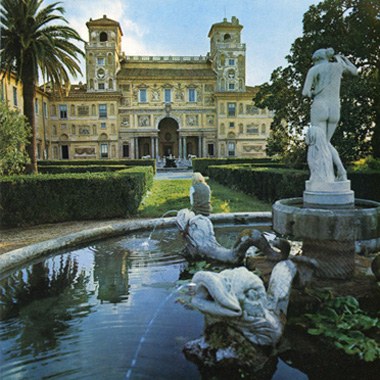
The Prix de Rome had been established by Colbert, minister to Louis XIV, to send artists to study the works of the Italian Renaissance; the French Academy in Rome was founded in 1666. Jean Marc Lange arrived at the Villa Medici in January 1966, three centuries later. André Malraux, General de Gaulle’s minister, abolished the competition in 1968, before setting new admission requirements in 1970.
1966 — 1969
The Roman years
His stay was strongly shaped by the personality of the director of the Villa Medici, Balthasar Klossowski de Rola, known as Balthus, a painter whose work he admired. Jean Marc Lange was often invited to his table together with the sculptor Jacqueline Georges Deyme. There they met Federico Fellini, Jacques Lacan, Tony Curtis, Alain Cuny, George Harrison, Raymond Masson… and even the New York dealer Pierre Matisse, who made a strong impression on him during a visit to his studio.
Eccentric abstraction
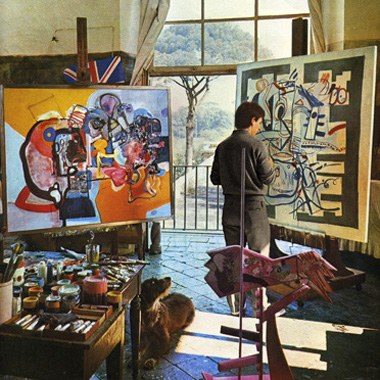
Jean Marc Lange experienced that first year in Rome as a tidal wave. From that place and its fierce light, with the Beatles playing all day long, came wild forms and colours. Still marked by the grey blast furnaces of Grand-Quevilly and the thick, damp mists of the Seine valley, in Italy he set out to paint differently, celebrating the great happiness of his new life.
Then, the beaches
Above all those of Ostia, working-class, colourful and lively, where Romans liked to settle in, spreading deckchairs, tents and tables on the sand, with the inevitable spaghetti enthroned on top, at the hour of “Midi à Ostie” (the title of one of his paintings). Felliniesque scenes that he relished noting in his little sketchbooks. Sometimes a mischievous libeccio, the south-westerly wind from Africa, sent hats and deckchairs flying… That wind heralded the canvases to come.
After Italy, these beaches never left him. Why the obsession with this theme? Simply because it is where Jean Marc Lange planted his universe: the subject, endlessly repeated, lets the form evolve. It is one and the same story told across many paintings, one and the same painting pursued without a break.
1969 — 1978
State commissions
At twenty-five Jean Marc Lange settled in La Celle-Saint-Cloud, near Paris, in a large studio close to that of Jacqueline Georges Deyme. Together they designed large metal sculptures and murals under the “1% for art” scheme, which devotes 1% of the construction budget of schools and public buildings to works of art developed with the architects of each project.
The town of Grand-Quevilly, through its mayor Tony Larue, commissioned several sculptures from its young native son for the schools it was building; Belfort, Grand-Charmont, Paris and Orléans followed. This new application of his craft fascinated him for a time, but he missed the calm of the studio: the freedom to act and decide without constraints rekindled his wish to devote himself to painting alone.
1972
La Celle-Saint-Cloud and the Assartx
René Lucien Duchesne, mayor of La Celle-Saint-Cloud, who married Jean Marc Lange and Jacqueline Georges Deyme in 1973, asked them to take part in the town’s artistic life by creating a sculpture workshop within the Assartx, an arts and cultural association bringing together a conservatoire of music, drama and dance with workshops in painting, sculpture and drawing. Masterfully run by the two artists, the workshop was an immediate success: almost 8,000 students attended it over thirty-seven years, and it was renowned throughout the region for the quality and spirit of its teaching.
Sculpture, printmaking and travels
Alongside his painting, Jean Marc Lange also works in sculpture, interpreting his subjects in three dimensions in marble, wax, bronze and terracotta. In the 1980s he produced etchings printed on the presses of the Frélaut-Lacourière studio and lithographs at Bramsen et Georges, published by the Marquet and Cupillard galleries, before turning to linocuts. A member of the Rotary Club for thirteen years, in 1979 he initiated a printmaking workshop in Louveciennes, which he ran until 1986.
He never stopped returning to the Italy of Michelangelo and Raphael. But other destinations also shaped the way he approached painting. Russia, where he accompanied Arnaud d’Hauterives, permanent secretary of the Académie des Beaux-Arts, on an artistic exchange, was perhaps the first step in his thinking about simplifying his line: visiting a printing works, he was struck by the effectiveness of results obtained with rudimentary techniques that forced a certain economy.
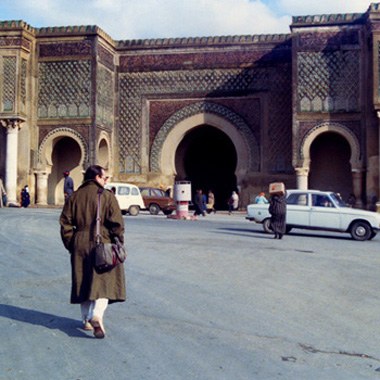
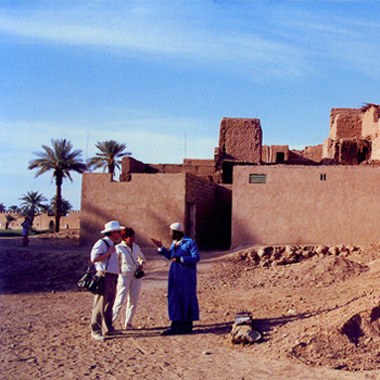
Morocco was rich in sensations, like those Eugène Delacroix had felt before its draped figures moving through such distinctive settings; he brought back countless sketches that gave rise to evocatively titled canvases. In Egypt, the frescoes of the tombs in the Valley of the Kings came as a shock: his painting carries, transposed, that black outline encircling the coloured forms, that demand for drawing needed to depict anything at all, that “probity of art” Ingres liked to invoke. Canada, Spain… each journey offered details that can be found in his work.
1989 — 1992
Patronage
At an exhibition in Bordeaux in 1984, Jean Marc Lange met Jean-Manuel Bajen, an industrialist and property developer. The meeting led to a patronage arrangement intended to support the production and circulation of the works, but the painter soon regained his independence. Jean-Manuel Bajen, who went on to own the Théâtre des Variétés in Paris, and Jean Marc Lange meet regularly among people from the arts and the stage.
1977 — 2014
Galleries and gallerists
In their gallery on rue Bonaparte in Paris, Arlette and Jacques Marquet represented artists of acid humour and singular imagination such as Roland Topor, Jean-Michel Folon, Michel Granger and Sempé. Close to them, Jean Marc Lange met Arlette Marquet, who, on discovering his painting, offered him a first exhibition in 1977. It was such a success that every work on show was sold very quickly; from then on, on the pretext of reporting back to him, Arlette Marquet regularly came to the studio hoping to take away new canvases. Thus began a lasting collaboration and, above all, an unshakeable friendship.
Other dealers then took his work beyond Paris: with the Jean-Marie Cupillard gallery, in Grenoble and Saint-Tropez, he took part in international fairs such as FIAC and ARCO in Madrid; the gallery Le Troisième Œil in Bordeaux, run by Anne-Marie Marquette, represented him for several years.
Above all, though, it was the Alain Blondel gallery that bore privileged witness to his development as a painter. Alain Blondel, an international expert on the work of Tamara de Lempicka, and his wife Michèle devoted several exhibitions to him, first on rue Aubry-le-Boucher near Beaubourg, then on rue Vieille-du-Temple in Paris, where his works were on permanent display. Together they took part in many events: the Lunéville museum, several editions of FIAC, the Los Angeles international fair. Alain Blondel also produced a book on Jean Marc Lange’s paintings, published by Garamont-Archimbaud. The collaboration grew into a close friendship and intellectual bond.
Painting as writing
“Painting is first of all a language of signs,” Picasso often said — which brings it close to writing, Jean Marc Lange points out. The axiom finds its full application in the development of his painting, especially in recent years: a radical, long-pondered simplification is taking place on his canvases, although the subjects remain the same. The black line becomes predominant; it confirms and imposes a deliberate drawing, serving pared-down compositions that promise a future rich in creativity.
Text based on the biography published on the artist’s website (2021) and the “Chaleur & Obsession” catalogue (2016).
Chronology
- 1945
- Born on 17 November in Canteleu, above Rouen; childhood in Grand-Quevilly, on the banks of the Seine. He tirelessly copies the reproductions of paintings and sculptures in the family Grand Larousse.
- 1961
- Admitted at fifteen to the École Régionale des Beaux-Arts in Rouen (Aître Saint-Maclou), directed by the architect François Herr, where he completes three years of general art studies.
- ≈ 1962
- Paints his first beaches at Saint-Aubin-sur-Mer. On the cliffs of Varengeville he meets Georges Braque, a year before Braque’s death: a few words exchanged encourage him to paint.
- 1964
- On 17 November the painter Maurice Brianchon accepts him into his studio at the École Nationale Supérieure des Beaux-Arts in Paris.
- 1965
- Ranked first of the fourteen candidates admitted to the “montée en loge”, he paints Le Songe in three months. In July a unanimous jury awards him, aged nineteen, the Premier Grand Prix de Rome for painting.
- 1966 — 1969
- Resident at the Villa Medici, directed by Balthus. At his table, with Jacqueline Georges Deyme, he meets Federico Fellini, Jacques Lacan, Tony Curtis, Alain Cuny and George Harrison; the New York dealer Pierre Matisse visits his studio. A first year of “eccentric abstraction”, then the beaches of Ostia.
- 1969 — 1978
- Public commissions under France’s “1% for art” scheme, with Jacqueline Georges Deyme: metal sculptures and murals for schools and public buildings in Grand-Quevilly, Belfort, Grand-Charmont, Paris and Orléans.
- 1972
- Studios in La Celle-Saint-Cloud. At the mayor’s request he founds, with Jacqueline Georges Deyme, the sculpture workshop of the Assartx association: some 8,000 students in thirty-seven years.
- 1977
- First exhibition at the Galerie Marquet (rue Bonaparte, Paris): every work is sold. Le Songe is shown at the Musée Picasso in Antibes (“Les cinquante derniers Premiers Grands Prix de Rome”).
- 1979 — 1986
- Founds and runs a printmaking workshop in Louveciennes. In the 1980s, etchings printed at the Frélaut-Lacourière studio, lithographs at Bramsen et Georges (published by Marquet and Cupillard), then linocuts; sculptures in marble, wax, bronze and terracotta.
- 1984
- In Bordeaux he meets Jean-Manuel Bajen, a businessman who later ran the Théâtre des Variétés in Paris: a friendship of more than thirty years and, from 1989 to 1992, a patronage supporting the production and circulation of the works.
- 1986
- Book on his paintings, text by Élisabeth Vedrenne, Éditions Garamont-Archimbaud (produced by Frédéric Birr and Alain Blondel). Artistic exchanges in Russia with Arnaud d’Hauterives, Permanent Secretary of the Académie des Beaux-Arts.
- 1986 — 2014
- Represented by Michèle and Alain Blondel, rue Aubry-le-Boucher then rue Vieille-du-Temple, Paris: FIAC, Lunéville, Los Angeles. Other dealers: Arlette and Jacques Marquet, Jean-Marie Cupillard (Grenoble, Saint-Tropez; FIAC, ARCO Madrid), Anne-Marie Marquette (Le Troisième Œil, Bordeaux).
- Travels
- Journeys that shape the painting: Russia (simplification of line), Morocco (many sketches, in Delacroix’s footsteps), Egypt (the black outline of the Valley of the Kings frescoes), Canada, Spain.
- 2016
- “Chaleur & Obsession”, with Jacqueline Georges Deyme, Matmut Centre for Contemporary Art (9 April — 26 June); catalogue, Éditions Carpentier.
Exhibitions 78
Titles and references are given in their original language.
- 2025
- « Peintures », Galerie Thibault Holscher — Paris
- 2016
- « Chaleur & Obsession », Matmut pour les Arts, Centre d’art contemporain — Saint-Pierre-de-Varengeville (9 avril — 26 juin)
- 2014
- Galerie Alain Blondel — Paris
- Hôtel de Ville — La Celle-Saint-Cloud
- 2010
- Galerie Alain Blondel — Paris
- Hôtel de Ville — La Celle-Saint-Cloud
- 2009
- Galerie Alain Blondel — Paris
- Galerie du Parc — Notre-Dame-de-Gravenchon
- 2007
- Galerie du Parc — Notre-Dame-de-Gravenchon
- Salon Comparaisons — Paris
- Galerie Alain Blondel — Paris
- 2006
- Théâtre des Variétés — Paris
- Galerie Alain Blondel — Paris
- 2005
- Galerie du Parc — Notre-Dame-de-Gravenchon
- Galerie Alain Blondel — Paris
- 2004
- Salon d’Automne — Paris
- 2003
- Salon de Rouen (invité d’honneur)
- 2001
- Galerie Alain Blondel — Paris
- 1997
- Galerie Alain Blondel — Paris
- 1996
- Salon d’Automne — Paris
- 1995
- Galerie Le Troisième Œil — Bordeaux
- Salon d’Automne — Paris
- 1994
- FIAC / Galerie Alain Blondel — Paris
- Salon de Mars — Paris
- 1993
- Art Paris / Galerie Cupillard — Paris
- 1992
- FIAC / Galerie Alain Blondel — Paris
- Galerie Alain Blondel — Paris
- 1991
- Galerie Le Troisième Œil — Bordeaux
- FIAC / Galerie Alain Blondel — Paris
- Galerie Cupillard — Saint-Tropez
- 1990
- Salon d’Angers
- FIAC / Galerie Alain Blondel — Paris
- Galerie Cupillard — Saint-Tropez
- Galerie Maguy Marraine — Lyon
- 1989
- FIAC / Galerie Alain Blondel — Paris
- Galerie Alain Blondel — Paris
- Foire internationale — Los Angeles (USA)
- 1988
- FIAC / Galerie Alain Blondel — Paris
- Galerie Le Troisième Œil — Bordeaux
- « Les pouvoirs du réel », musée de Lunéville / Galerie Alain Blondel
- 1987
- FIAC / Galerie Alain Blondel — Paris
- ARCO / Galerie Cupillard — Madrid
- Galerie Cupillard — Saint-Tropez
- Salon des Artistes Français — Paris
- Rencontre d’Art, musée des Beaux-Arts — Pau
- 1986
- FIAC / Galerie Alain Blondel — Paris
- Galerie Alain Blondel — Paris
- Les Artistes Français — Moscou
- 1985
- ARCO / Galerie Cupillard — Madrid
- FIAC / Galerie Alain Blondel — Paris
- Salon des Artistes Français — Paris
- 1984
- Galerie Cupillard — Grenoble
- FIAC / Galerie Cupillard — Paris
- Galerie Le Troisième Œil — Bordeaux
- Salon des Artistes Français — Paris
- « Sur invitation », musée des Arts décoratifs — Paris
- 1983
- FIAC / Galerie Cupillard — Paris
- Salon des Artistes Français — Paris
- 1982
- FIAC / Galerie Cupillard — Paris
- Salon des Artistes Français — Paris
- 1981
- FIAC / Galerie Cupillard — Paris
- Salon des Artistes Français — Paris
- 1980
- Galerie Cupillard — Grenoble
- Salon des Artistes Français — Paris
- Galerie Étienne de Causans — Paris
- 1978
- FIAC / Galerie Marquet — Paris
- Galerie Marquet — Paris
- 1977
- Galerie Marquet — Paris
- « Les cinquante derniers Premiers Grands Prix de Rome », musée Picasso — Antibes
- 1974
- Galerie Graffiti — Rouen
- 1970
- Galerie Le Grand-Cerf — Évreux
- 1969
- Salon de Mai — Paris
- 1968
- Petit Palais — Paris
- 1967
- Villa Médicis — Rome
- Palais Strozzi — Florence
- 1966
- Galerie Le Grand-Cerf — Évreux
- 1965
- Musée des Beaux-Arts — Rouen
- 1964
- Galerie l’Armitière — Rouen
Publications, radio and television
- 2016
- Chaleur & Obsession — Lange, peintures ; Deyme, sculptures, Éditions Carpentier, 119 p.
- 2006
- Arts Actualités Magazine, n° 150, mars-avril
- Azart, le magazine international de la peinture, n° 19, mars-avril
- 2004
- Catalogue du Salon d’Automne — Paris
- 1994
- Catalogue du Salon de Mars — Paris
- 1992
- L’Amateur d’Art, octobre-novembre — textes d’Aline Boutin, Marie-Ange Crespo et Jacques Dubois
- 1991
- Montrer, revue d’art n° 8, septembre — article de Marie Prasle
- Catalogue « 10 ans d’art contemporain » (1981-1991), Galerie Cupillard — Grenoble
- 1990
- L’Œil, revue d’art n° 423
- 1989
- Artspeak, New York, 16 décembre — article de Théo Barbu
- Connaissance des Arts, n° 452, octobre
- 1988
- Catalogue « Les pouvoirs du réel », musée du château de Lunéville — préface de Pierre Chanel et Alain Blondel
- FR3 Haute-Normandie, Midi 3 — reportage du 22 janvier
- 1987
- Radio Saint-Tropez — présentation du peintre Jean Marc Lange et de l’acteur Laurent Mallet
- 1986
- Livre sur les peintures de Jean Marc Lange, texte d’Élisabeth Vedrenne, produit par Frédéric Birr et Alain Blondel, Éditions Garamont-Archimbaud — Paris
- Décoration internationale, octobre-novembre
- 1985
- Radio Libertaire — 60 minutes d’entretien avec Hélène Majera, Jacqueline Georges Deyme et Jean Marc Lange
- 1984
- Catalogue « Sur invitation », musée des Arts décoratifs de Paris — préface de Robert Bordaz
- 1983
- Revue du Rotarien international, octobre — tableau en couverture
- 1981
- FR3 Haute-Normandie — reportage de Roger Parment
- Catalogue de la FIAC — Grand Palais, Paris
- Catalogue Jean Marc Lange, galerie Étienne de Causans — préface de Rémi-Francis Parment
- Le Figaro, vendredi 11 décembre — « Le monde sauvage de Lange », par Pierre Mazars
- 1979
- Catalogue Jean Marc Lange, Éditions Jean-Marie Cupillard — Grenoble
- 1974
- ORTF 3e chaîne, Télé-Normandie — reportage de Roger Parment
- 1969
- RAI — émission musicale avec Jean Marc Lange et le compositeur Pierre Petit — Rome
- 1968
- Plaisir de France, janvier — texte de Gilles Quéant
- 1967
- ORTF, pôle régional Télé-Normandie — reportage de Roger Parment
- ORTF 1re chaîne, « Artistes de la Villa Médicis » — reportage de Pierre Nivolet
- 1966
- ORTF, pôle régional Télé-Normandie — reportage de Roger Parment
- 1965
- France Inter, « Inter jeunes », animée par Victor Azaria — « Jean Marc Lange, jeune et Prix de Rome », 120 minutes d’entretien
- Radio Haute-Normandie — 60 minutes d’entretien, présenté par Alain Gerbi
- Paris-Normandie, à la une du 7 juillet (n° 6688)
- Europe n° 1, « Grand Prix de Rome à 19 ans » — en direct de l’École nationale supérieure des Beaux-Arts, 6 juillet
Archive photographs
Sources: the artist’s website (2021 version); “Chaleur & Obsession” catalogue, Éditions Carpentier, 2016; Galerie Thibault Holscher.